
























DSC Performance Validation: Baseline Stability, Temperature Range, and Data Reproducibility
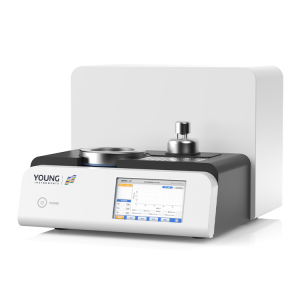
Differential Scanning Calorimetry (DSC) is a thermal analysis technique that measures the heat flow difference between a sample and a reference to precisely record enthalpy changes under a controlled temperature program. It is widely used across polymers, pharmaceuticals, food, coatings, and metals to determine key thermal properties including glass transition, melting/crystallization, curing, oxidation stability, and specific heat capacity.
Introduction
Core DSC performance depends on heat flow sensor sensitivity, temperature control accuracy, and data reproducibility. The following sections present key performance metrics across baseline stability, temperature range, and certified reference verification.
High Resolution & Sensitivity
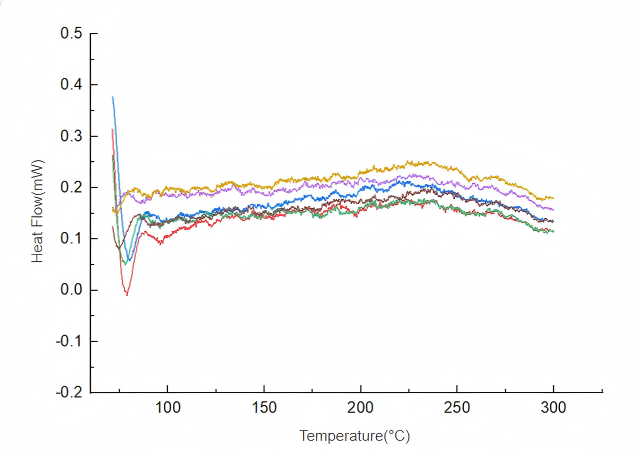
An oxidation-resistant, high-performance heat flow sensor combined with refined structural design enhances heat transfer efficiency and eliminates cross-talk between sample and reference signals. This establishes a stable, reliable heat flow baseline. Without baseline subtraction, the heat flow signal approaches zero. Baseline drift is ≤100 μW, with inter-test baseline variation ≤0.04 mW, demonstrating excellent baseline stability and repeatability.
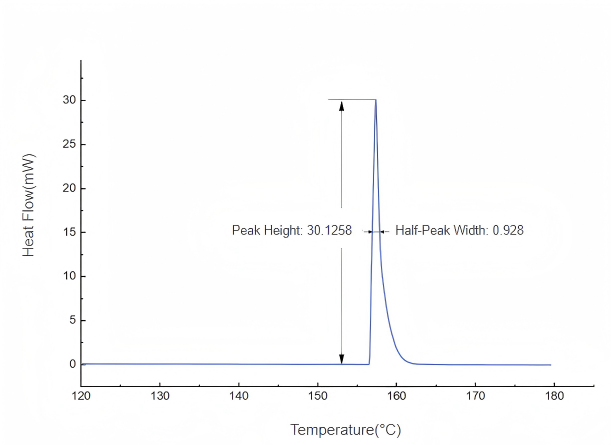
Indium peak height / half-peak width ≥20.0 mW/K ensures high sensitivity and resolution.
Wide Temperature Range & Precise Control
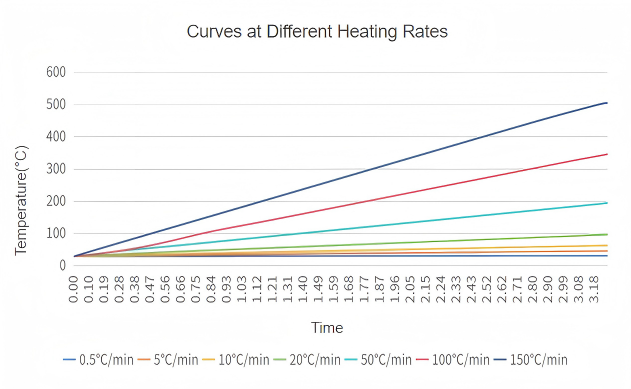
An integrated silver furnace delivers high heat transfer efficiency and precise temperature control. The experimental temperature range covers −90 °C to 700 °C, with maximum heating rates up to 200 °C/min, enabling efficient characterization of material behavior under processing conditions.
Reliable Data Reproducibility
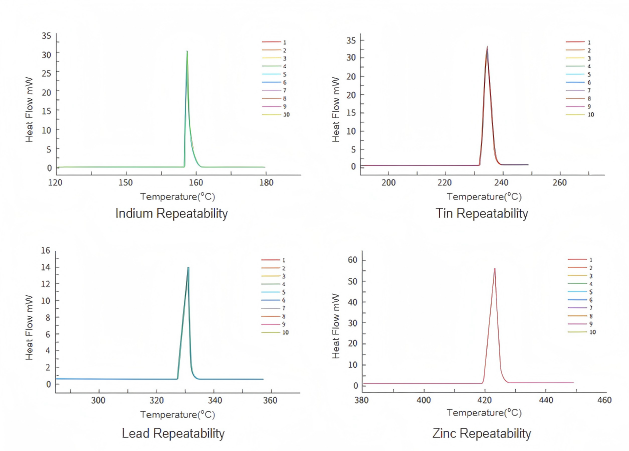
High-frequency data acquisition combined with optimized structural design ensures stable baselines and excellent signal-to-noise ratios. Phase transition temperature precision is ±0.02 °C (In standard), and enthalpy measurement accuracy is ±0.08% (In). A feedforward intelligent prediction system combined with high-precision atmosphere flow control compensates for dynamic disturbances, delivering rapid and stable instrument response.