
























DSC Case Studies: Thermal Characterization Across Industries
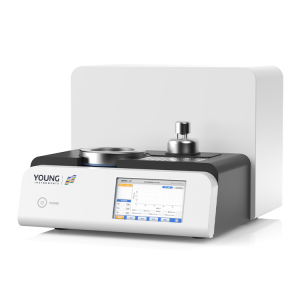
DSC technology spans materials science, pharmaceuticals, chemicals, and new energy. The following cases illustrate typical applications and key data in rubber vulcanization, polymer characterization, pharmaceutical amorphous form screening, chemical thermal safety assessment, and battery material analysis.
Case 1: Rubber Vulcanization
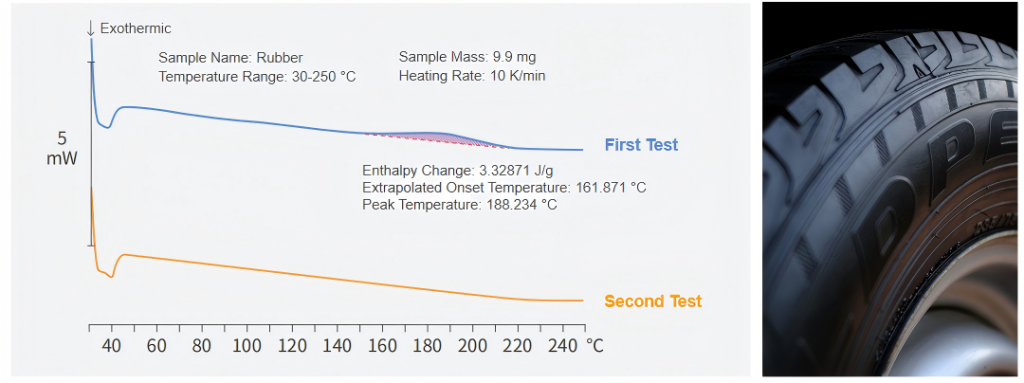
Rubber vulcanization is a critical step in rubber processing. The DSC exothermic peak area evaluates the degree of vulcanization, optimizing curing time for peak performance. This case resolved a weak curing exotherm of 3.33 J/g, enabling precise reaction characterization.
Case 2: Glass Transition of Polymers
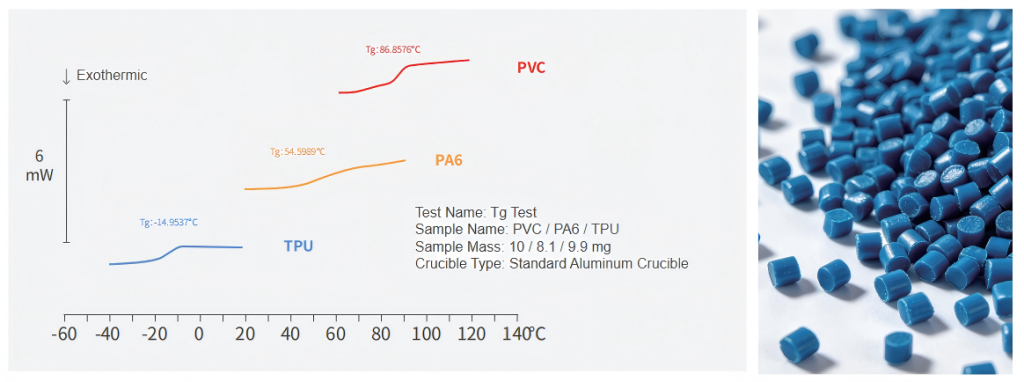
Tg governs polymer rigidity, low-temperature toughness, and service limits. Measured values: PVC 86.86 ℃, PA6 54.60 ℃, TPU –14.95 ℃. Data supports material selection, molding process design, and low-temperature stability evaluation
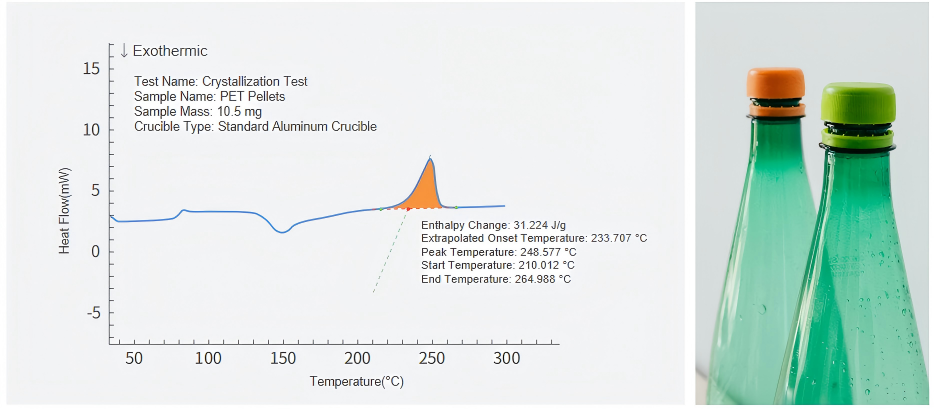
Case 3: PET Crystallinity
Crystallinity governs polymer physical and mechanical properties. This case quantified PET chip crystallinity by the enthalpy method, measuring a melting enthalpy of 31.22 J/g (thermal history eliminated). Results support performance evaluation and injection molding process optimization.
Case 4: Amorphous Form Determination
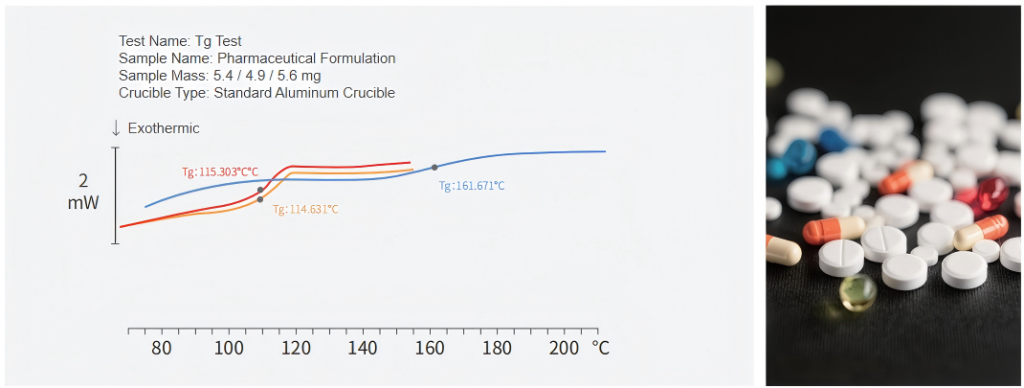
Tg is the critical mobility threshold for amorphous pharmaceuticals: stable below, recrystallization risk above. DSC second heating (thermal history erased) yielded Tg at 115.30 ℃ (Sample 1), 114.63 ℃ (Sample 2), and 161.67 ℃ (Sample 3), with no melting peaks detected, confirming amorphous state for all three APIs. The Tg spread directly reflects thermodynamic stability differences, supporting formulation screening and shelf-life assessment.
Case 5: Decomposition Heat of a TCCA Mixed Sample
Decomposition heat assessment is critical for thermal stability evaluation and explosion risk control. This case measured a total decomposition heat of 478.26 J/g for the TCCA mixed sample, indicating moderate explosion hazard (Rating 2). Targeted safety controls are required.
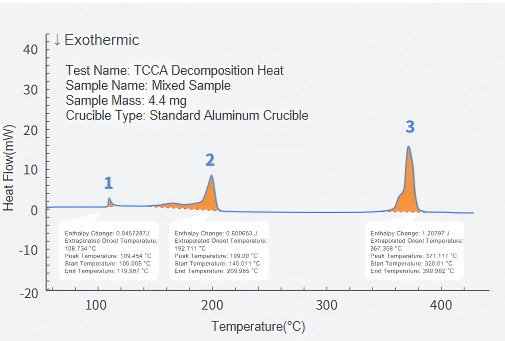
| Peak | Start Temperature (℃) | Extrapolated Onset Temperature (℃) | Peak Temperature (℃) | End Temperature (℃) | Total Heat of Decomposition of Mixture (J/g) |
| 1 | 100.005 | 108.734 | 109.454 | 119.987 | 478.262 |
| 2 | 140.011 | 192.711 | 199.09 | 209.985 | |
| 3 | 320.01 | 367.358 | 371.117 | 399.992 |
| Rating | Heat of Decomposition (J/g) | Description |
| 1 | <400 | Low explosion hazard |
| 2 | 400–1200 | Moderate explosion hazard |
| 3 | 1200–3000 | High explosion hazard |
| 4 | ≥ 3000 | Severe explosion hazard |
Case 6: HOBT and HOAT Thermal Analysis
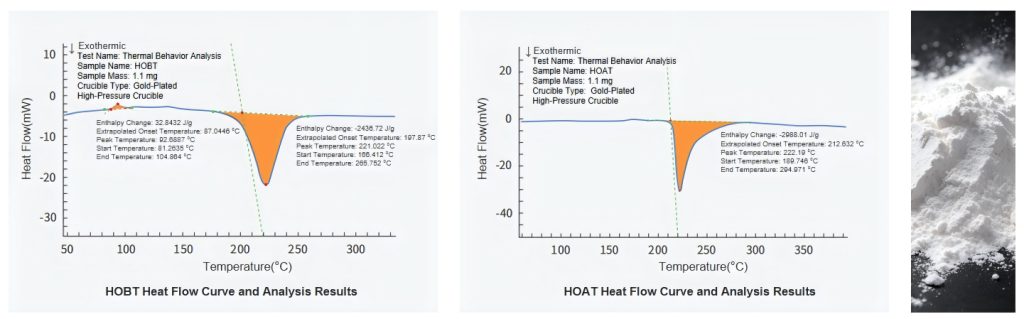
Gold-plated high-pressure crucibles are required for corrosive, gas-evolving organic coupling agents. HOBT exhibits weak endothermic melting at 81–105 ℃ (+32.84 J/g, onset 87.04 ℃) followed by strong exothermic decomposition at 166–266 ℃ (–2436.72 J/g, onset 197.87 ℃, peak 221.02 ℃). HOAT shows a single exothermic decomposition peak at 190–295 ℃ (–2988.01 J/g, onset 212.63 ℃, peak 222.19 ℃) with no detectable melting transition. Thermal decomposition parameters guide process application and safety assessment.
Case 7: Thermal Decomposition of Organic Peroxides
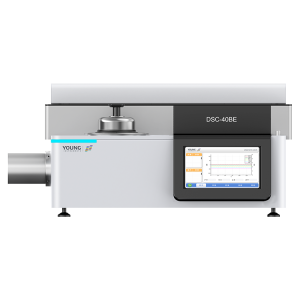
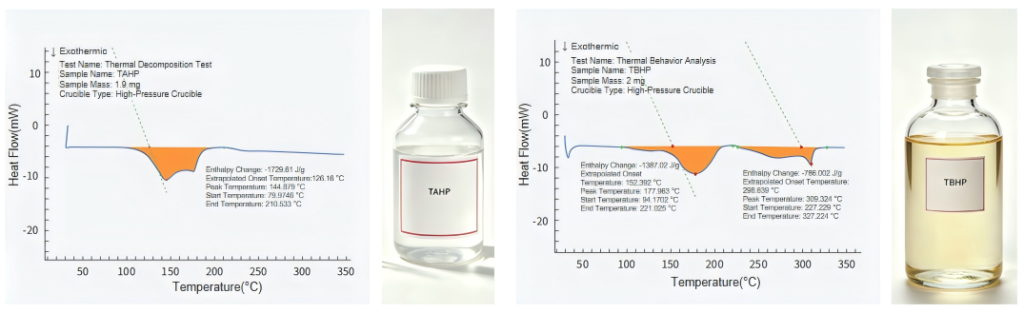
DSC-40AE with gold-plated high-pressure crucibles tested TAHP (tert-amyl hydroperoxide) and TBHP (tert-butyl hydroperoxide). TAHP showed single-stage exothermic decomposition (ΔH –1729.61 J/g); TBHP exhibited two-stage exothermic decomposition (total ΔH –2173.02 J/g). Both release substantial heat with significant thermal runaway and explosion risk, requiring strict temperature control.
Case 8: Lithium-Ion Battery Materials
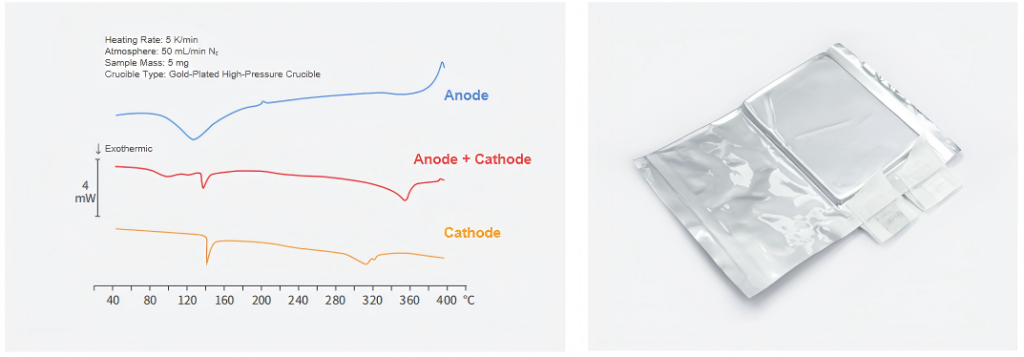
DSC-40AE with gold-plated high-pressure crucibles characterized cathode, anode, and mixed electrode samples across 40–400 ℃ (5 K/min, 50 mL/min N₂). These hermetic crucibles retain volatile decomposition products. Comparative heat flow profiles distinguish thermal stability between single-electrode and mixed electrode systems, supporting electrode formulation optimization and thermal runaway mechanism research.