





















Traceable Performance Validation for Battery Adiabatic Calorimeters
The core performance metric of a battery adiabatic calorimeter is self-heating detection sensitivity — the ability to identify weak heat release from the sample. This metric critically influences the accuracy of characteristic temperatures such as the self-heating onset temperature (T1). High sensitivity requires optimized structural design, precision temperature measurement, and efficient temperature-control algorithms to achieve superior adiabatic performance.
Without unified metrological standards for complete-system validation, objective performance evaluation remains challenging. Instruments with suboptimal adiabatic performance produce unreliable data that directly undermine battery system safety design.
Conventional validation using lithium-ion cells as reference samples introduces significant uncertainty: batch-to-batch variations in internal structure and materials compromise data consistency, while violent thermal runaway events risk instrument contamination, damage, and stringent site requirements.
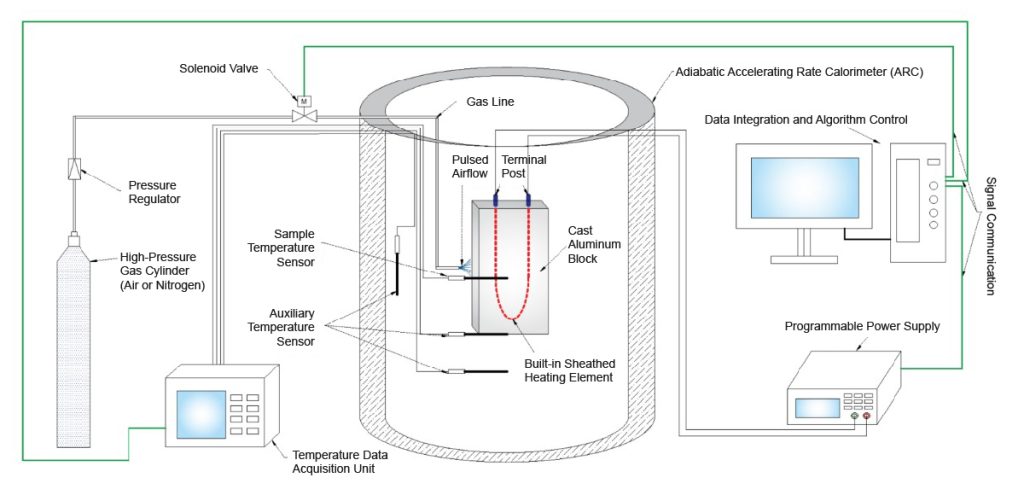
To overcome these limitations, a traceable validation protocol based on Joule-heating generation is employed. Using a standard resistive block with embedded heating tube, a programmable power supply simulates battery thermal runaway temperature-rise profiles with known, calculable outputs. This method is traceable, highly accurate, non-destructive, and reproducible.
Validation Method
The reference block is suspended in the adiabatic calorimeter and subjected to Heat-Wait-Seek (HWS) mode testing. Theoretical characteristic temperatures and temperature-rise rates at each step are compared against measured values to verify instrument sensitivity and accuracy.
Validation Results
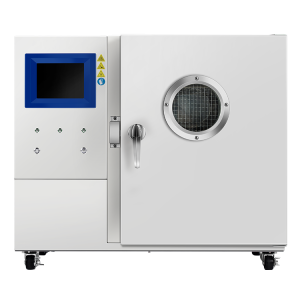
BAC-420AE
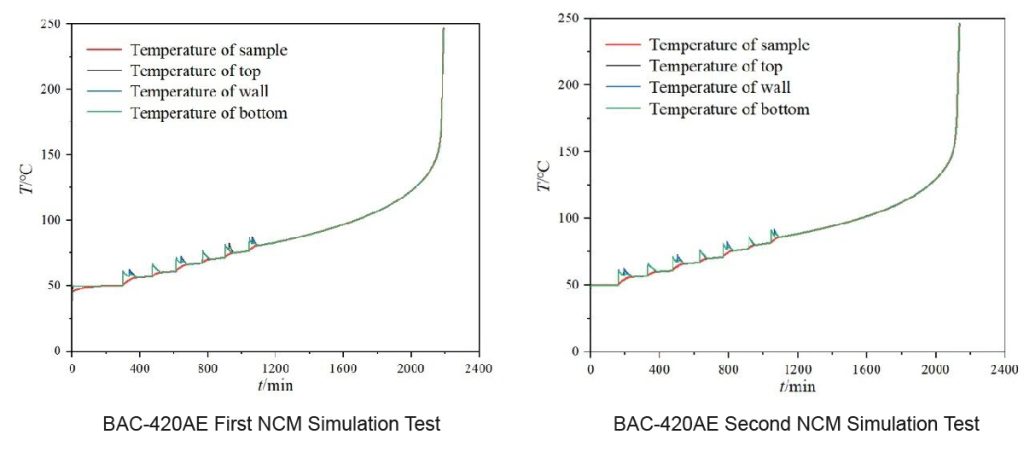
Adiabatic thermal runaway simulation experiments were conducted for NCM cells. The reference sample had a theoretical T₁ of 80.0 °C (corresponding to a temperature-rise rate of 0.02 °C/min). T₁ was detected at 80 °C and 85 °C in two separate runs, both within the expected tolerance.
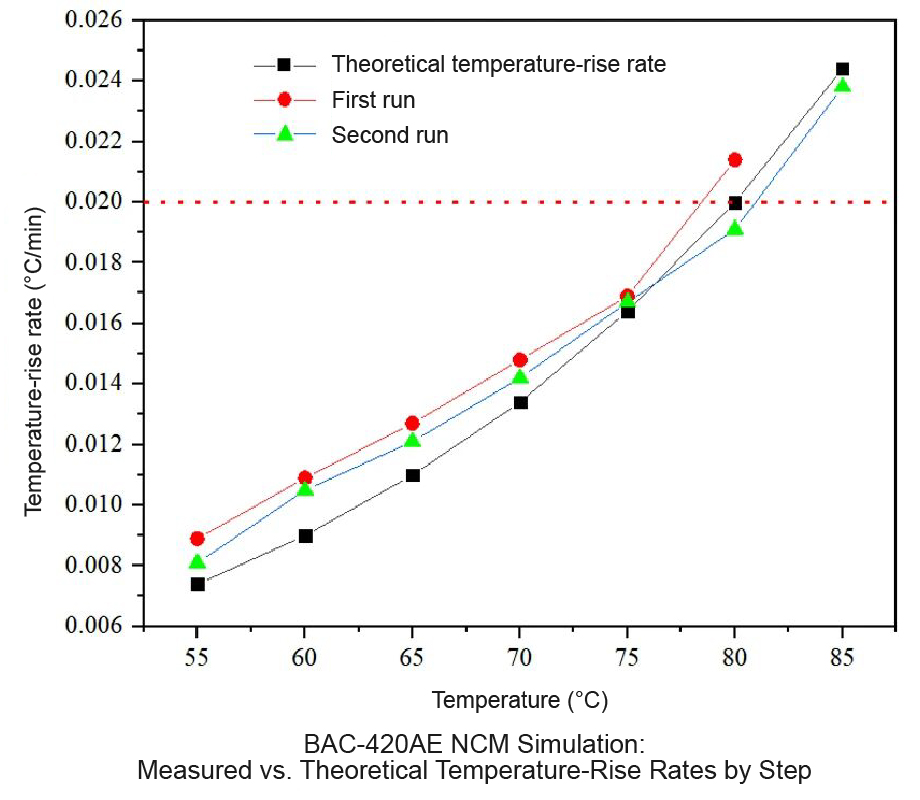
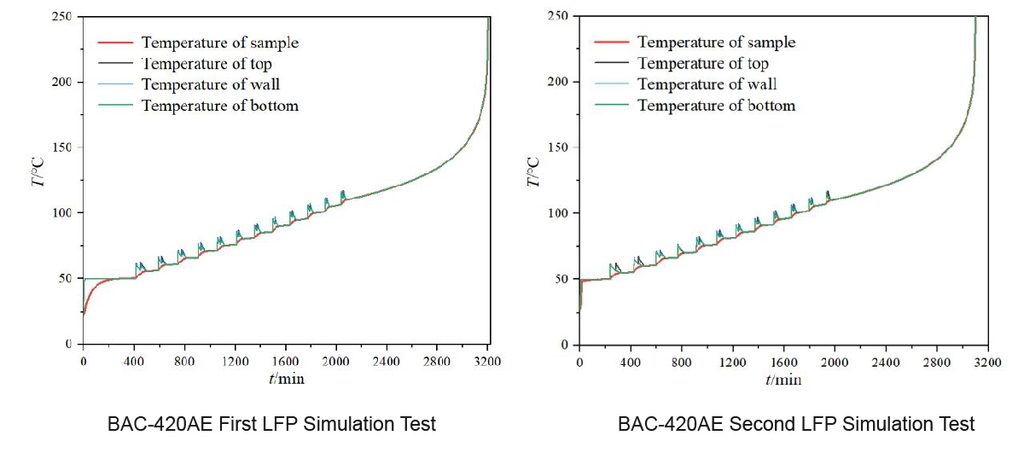
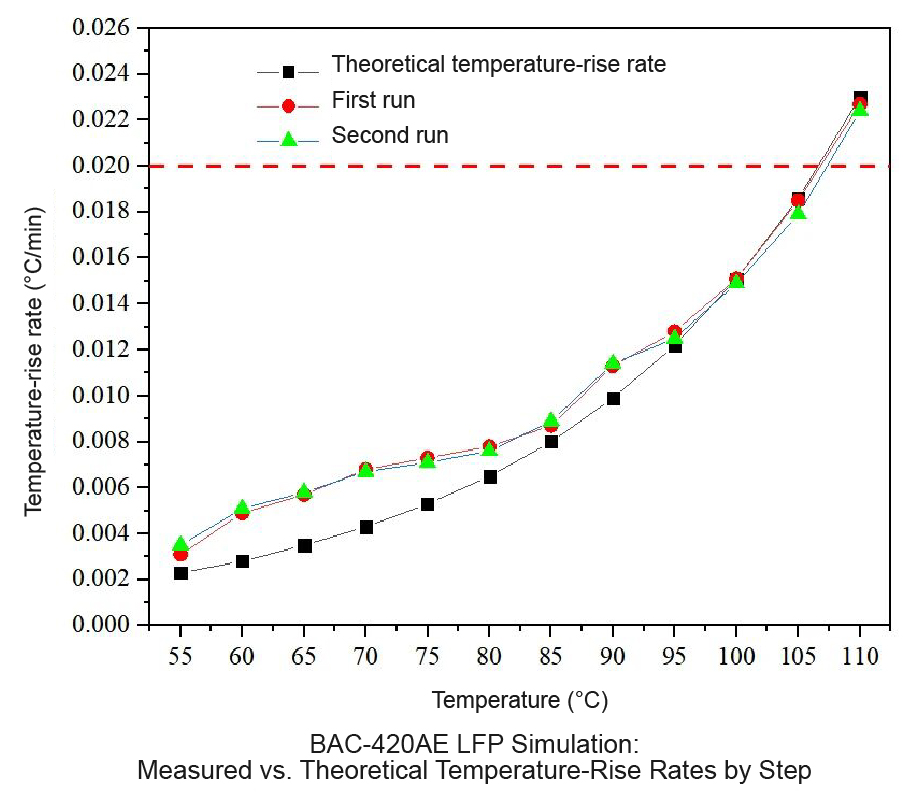
Adiabatic thermal runaway simulation experiments were conducted for LFP cells. The reference sample had a theoretical T₁ of 106.7 °C. T₁ was detected at 110 °C in both runs, within the expected 5 °C step tolerance. Deviations between measured and theoretical temperature-rise rates at each step were within ±0.003 °C/min.
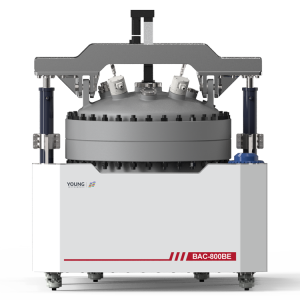
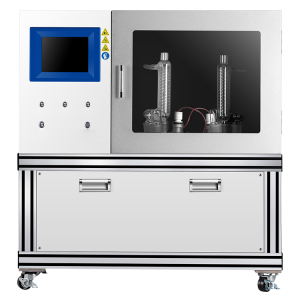
BAC-800BE
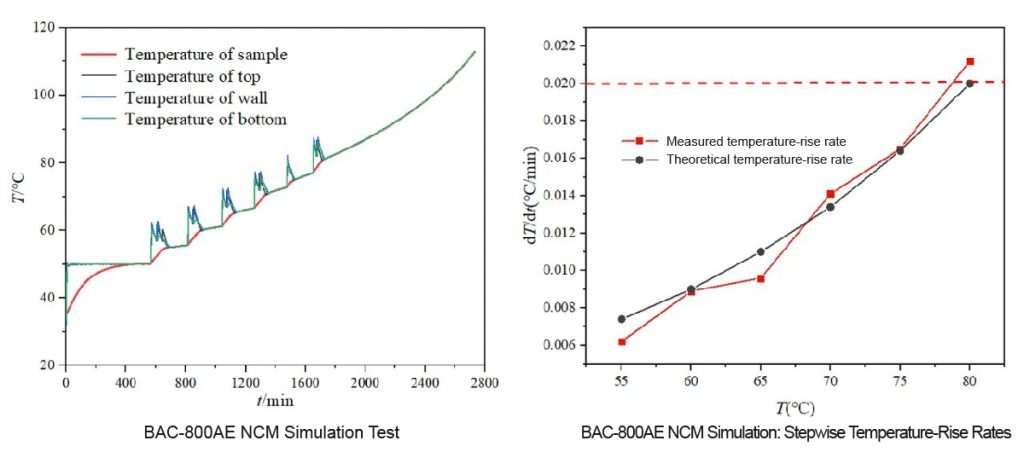
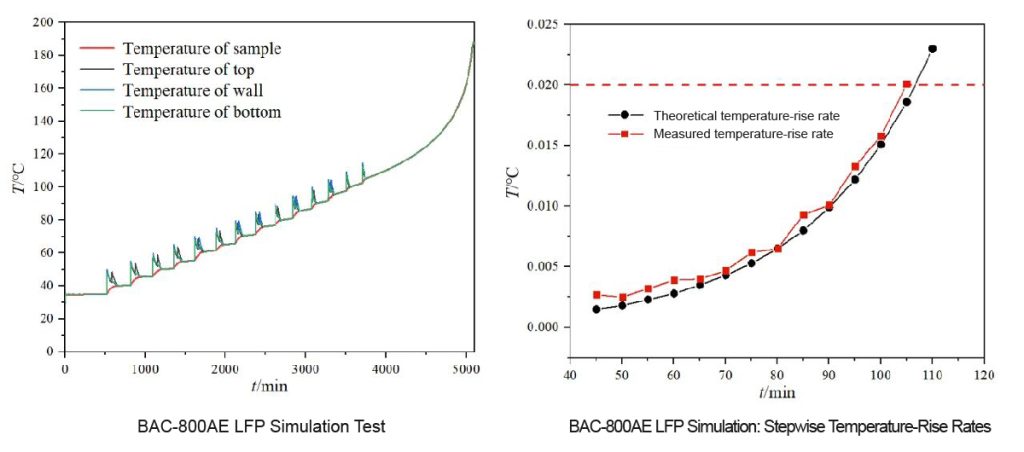
Adiabatic thermal runaway simulation experiments were conducted for NCM and LFP cells. T₁ was detected at 80 °C and 105 °C, respectively, both within expected tolerance. Deviations between measured and theoretical temperature-rise rates at each step were within ±0.003 °C/min.
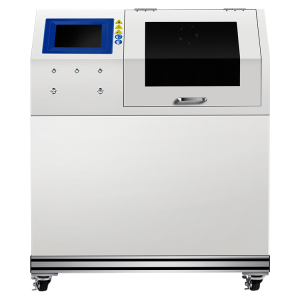
BAC-1000AE
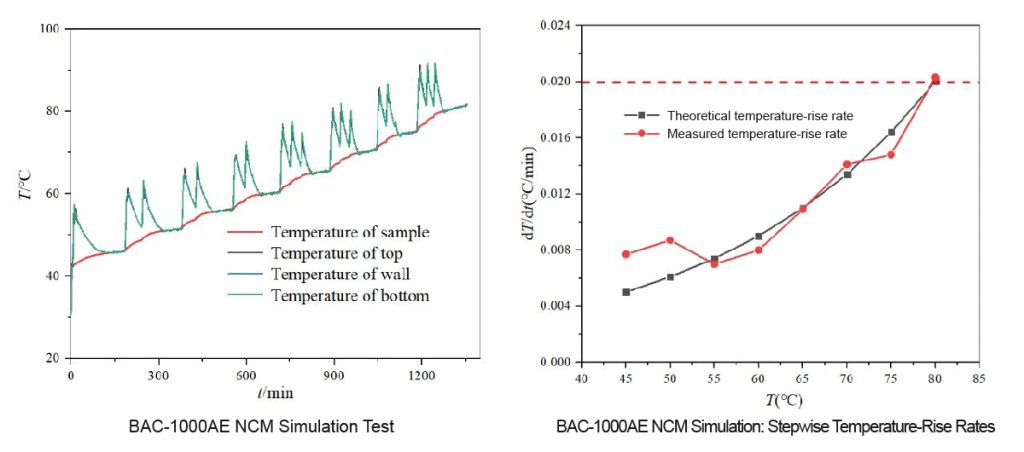
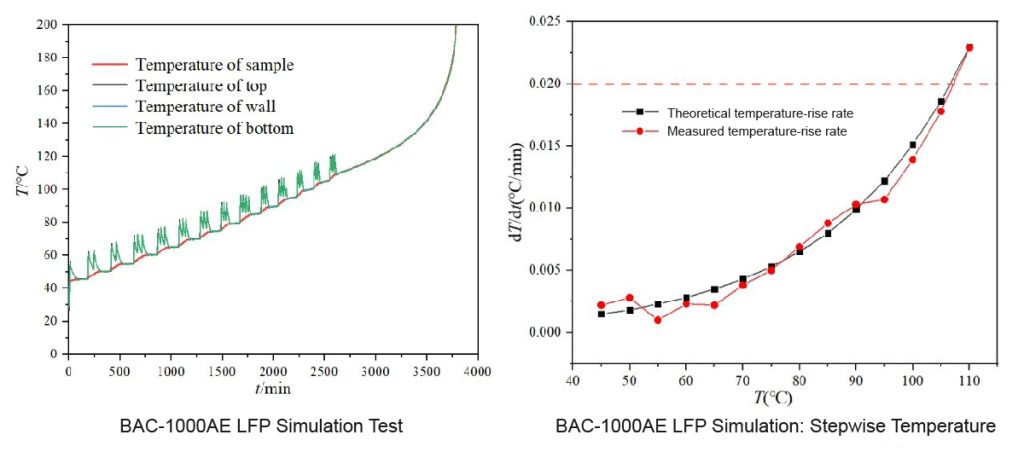
Adiabatic thermal runaway simulation experiments were conducted for NCM and LFP cells. T₁ was detected at 80 °C and 110 °C, respectively, both within expected tolerance. Deviations between measured and theoretical temperature-rise rates at each step were within ±0.005 °C/min.
Conclusion
This traceable validation protocol provides objective, quantitative confirmation of key performance metrics across the BAC series. The results demonstrate consistent adiabatic tracking, precise self-heating detection, and reliable data output—the foundation for trustworthy battery thermal safety assessment.


